

Anterior Cutaneous Nerve Entrapment Syndrome (ACNES) Treatment in Kolkata

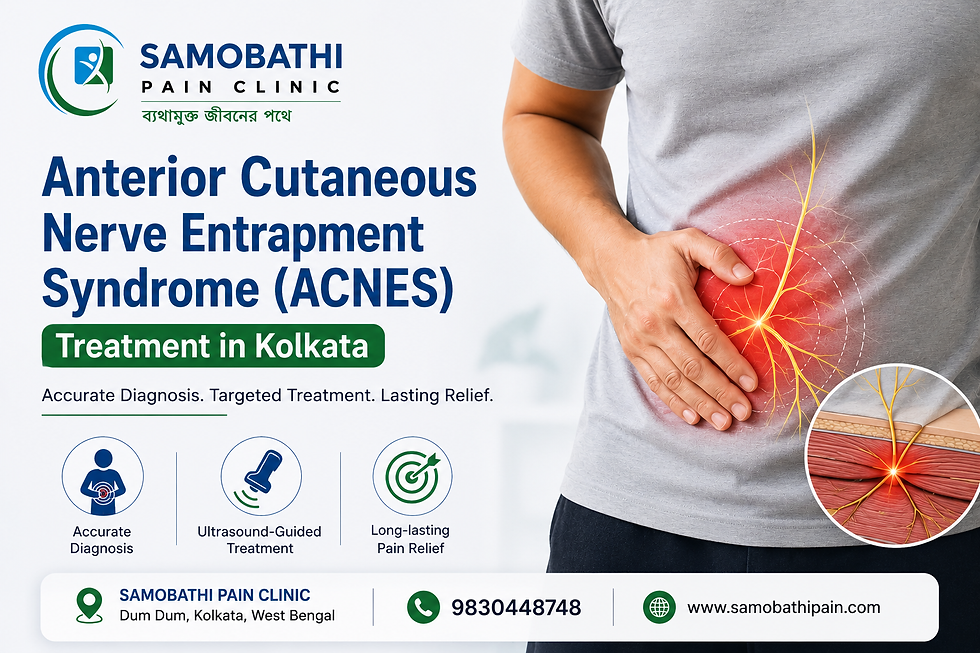
Persistent abdominal pain is often attributed to problems involving the stomach, intestines, gallbladder, kidneys, or other abdominal organs. However, in some patients, repeated investigations such as ultrasound, CT scan, MRI, endoscopy, and blood tests are completely normal, yet the pain continues.
One often-overlooked cause of chronic abdominal pain is Anterior Cutaneous Nerve Entrapment Syndrome (ACNES), a condition caused by entrapment of small sensory nerves supplying the abdominal wall.
If you are looking for Anterior Cutaneous Nerve Entrapment Syndrome (ACNES) treatment in Kolkata, understanding this condition is the first step toward obtaining the correct diagnosis and effective treatment.
What Is Anterior Cutaneous Nerve Entrapment Syndrome (ACNES)?
Anterior Cutaneous Nerve Entrapment Syndrome (ACNES) is a condition in which one of the small cutaneous branches of the lower thoracic intercostal nerves becomes trapped as it passes through the abdominal wall muscles and fascia.
This nerve compression causes chronic pain that originates from the abdominal wall rather than from the internal organs.
Although ACNES is one of the common causes of chronic abdominal wall pain, it is frequently misdiagnosed because routine imaging and laboratory investigations are often normal.
What Causes Anterior Cutaneous Nerve Entrapment Syndrome (ACNES)?
Several factors may contribute to nerve entrapment, including:
Previous abdominal surgery
Caesarean section (C-section)
Laparoscopic surgery
Hernia repair
Sudden twisting movements
Heavy lifting
Sports injuries
Repetitive strain
Pregnancy-related stretching of the abdominal wall
Scar tissue formation
In some patients, no obvious cause can be identified.
Can ACNES Develop After Surgery?
Yes.
Anterior Cutaneous Nerve Entrapment Syndrome may develop after abdominal surgery due to:
Scar formation
Nerve irritation
Fascial tightening
Entrapment during healing
Patients often report persistent pain near a surgical scar despite normal healing of the wound.
Common surgeries associated with ACNES include:
Caesarean section
Appendicectomy
Laparoscopic procedures
Hernia repair
Gallbladder surgery
Hysterectomy
Symptoms of Anterior Cutaneous Nerve Entrapment Syndrome (ACNES)
The symptoms are often very characteristic.
Patients commonly experience:
Localised abdominal pain
Sharp or stabbing pain
Burning pain
Tenderness over a small spot
Pain that increases on standing
Pain while coughing or sneezing
Pain during exercise
Pain when tightening the abdominal muscles
Pain while getting out of bed
Many patients can point to the painful area using one finger.
Where Is the Pain Usually Felt?
Pain most commonly occurs:
Around the umbilicus
Lower abdomen
Right lower abdomen
Left lower abdomen
Along previous surgical scars
The pain is usually confined to a small area measuring only a few centimetres.
How Is ACNES Different from Abdominal Organ Pain?
Unlike pain arising from internal organs, ACNES pain:
Is highly localised
Becomes worse when the abdominal muscles contract
Is reproducible by pressing one small point
Usually shows normal ultrasound, CT scan, MRI, and endoscopy findings
This difference is important because the treatment approach is completely different.
Carnett's Sign – A Simple Clinical Test
One of the most useful bedside tests for diagnosing ACNES is Carnett's Sign.
During the examination:
The doctor identifies the painful spot.
The patient is asked to tense the abdominal muscles by lifting the head or legs.
If the pain remains the same or becomes worse, it suggests that the pain originates from the abdominal wall rather than the internal organs.
Carnett's Sign is an important clue in diagnosing ACNES.
How Is Anterior Cutaneous Nerve Entrapment Syndrome Diagnosed?
Diagnosis is primarily based on:
Detailed medical history
Clinical examination
Localised tenderness
Positive Carnett's Sign
Exclusion of abdominal diseases
Diagnostic local anaesthetic nerve block
A significant reduction in pain following a diagnostic nerve block strongly supports the diagnosis.
Do I Need MRI or CT Scan?
Imaging studies are not used to diagnose ACNES directly.
However, your doctor may recommend ultrasound, CT scan, or MRI to exclude other abdominal conditions when appropriate.
Normal imaging does not rule out ACNES.
Anterior Cutaneous Nerve Entrapment Syndrome (ACNES) Treatment in Kolkata
Treatment depends on the severity and duration of symptoms.
Conservative Treatment
Initially, treatment may include:
Activity modification
Oral medications
Neuropathic pain medicines
Physiotherapy in selected cases
However, persistent symptoms often require interventional pain management.
Image-Guided Interventional Pain Procedures
One of the most effective approaches for Anterior Cutaneous Nerve Entrapment Syndrome (ACNES) treatment in Kolkata is ultrasound-guided intervention.
These procedures improve accuracy while reducing the risk of complications.
Treatment options include:
Ultrasound-Guided Anterior Cutaneous Nerve Block
A local anaesthetic, sometimes combined with anti-inflammatory medication, is injected around the entrapped nerve under ultrasound guidance.
This procedure serves both diagnostic and therapeutic purposes.
Hydrodissection
Ultrasound-guided hydrodissection involves carefully injecting fluid around the entrapped nerve to release it from surrounding scar tissue or fascial adhesions.
Many patients experience significant pain relief after this minimally invasive procedure.
Pulsed Radiofrequency
For patients with persistent neuropathic pain, pulsed radiofrequency may be considered to modulate nerve function without causing significant nerve destruction.
Surgical Neurectomy
Surgery is reserved for carefully selected patients who continue to experience disabling pain despite conservative treatment and image-guided interventions.
What Are the Advantages of Ultrasound-Guided Treatment?
Ultrasound guidance offers several advantages:
Precise localisation of the nerve
Real-time visualisation
Increased safety
Improved treatment accuracy
Greater patient comfort
Minimally invasive
Day-care procedure
Recovery After Treatment
Most patients return home on the same day.
Recovery recommendations include:
Avoid strenuous activity for 24–48 hours
Follow prescribed exercises
Attend follow-up appointments
Report recurrence of symptoms promptly
Recovery varies depending on the duration and severity of the condition.
When Should You Consult a Pain Physician?
You should seek medical evaluation if:
Abdominal pain has persisted for several weeks.
Investigations are normal but the pain continues.
Pain is localised to one small spot.
Pain worsens while sitting up, coughing, or exercising.
Previous treatments have not provided lasting relief.
Early diagnosis can prevent unnecessary investigations and prolonged suffering.
Why Choose Samobathi Pain Clinic for Anterior Cutaneous Nerve Entrapment Syndrome (ACNES) Treatment in Kolkata?
At Samobathi Pain Clinic, patients undergo a comprehensive evaluation to identify the exact source of abdominal wall pain.
When appropriate, treatment may include advanced ultrasound-guided interventional pain procedures performed using evidence-based techniques in a dedicated pain clinic setting.
The goal is to accurately diagnose the pain generator and provide personalised, minimally invasive treatment that helps patients return to normal daily activities.
Frequently Asked Questions
Is ACNES a serious condition?
ACNES is not usually life-threatening, but it can significantly affect quality of life due to persistent abdominal pain.
Can ACNES occur after surgery?
Yes. Previous abdominal surgery is one of the recognised causes of anterior cutaneous nerve entrapment.
Does ACNES show on MRI?
Usually not. MRI and CT scans are often normal because the condition affects small peripheral nerves.
Is ultrasound-guided nerve block painful?
The procedure is minimally invasive and is generally well tolerated. Ultrasound guidance improves precision and patient comfort.
Can ACNES be cured?
Many patients experience significant or complete relief after appropriate diagnosis and treatment. Some may require more than one intervention depending on the underlying cause and duration of symptoms.
Final Thoughts
Persistent abdominal pain with normal investigations should not be ignored. Anterior Cutaneous Nerve Entrapment Syndrome (ACNES) is an important but frequently overlooked cause of chronic abdominal wall pain.
If you are searching for Anterior Cutaneous Nerve Entrapment Syndrome (ACNES) treatment in Kolkata, early evaluation by an experienced Pain Physician can help identify the condition and determine whether conservative management or advanced ultrasound-guided interventional pain procedures are appropriate.
With accurate diagnosis and timely treatment, many patients can achieve long-lasting pain relief and return to their normal daily activities.


Comments